Material Selection Guide
A practical guide for engineers, buyers, and project teams who need to specify the right quartz glass grade before requesting a quotation.
Fused quartz and fused silica are not always interchangeable.
Many enquiries start with one word: quartz. But for optical, thermal, and precision applications, the difference between fused quartz and fused silica can affect cost, lead time, and performance. This guide explains what they share, where they differ, and how to choose the right starting point.
Quick answer: which material should you start with?
| Application | Better starting point |
|---|---|
| Mechanical or thermal parts | Fused quartz |
| Tubes, fixtures, carriers, sight glasses | Fused quartz |
| Deep-UV optical path | UV-grade fused silica |
| Specific IR window or lens | Grade-matched fused silica or low-OH quartz |
| Unsure about wavelength, temperature, or environment | Review the application before quoting |
The one real difference
Both materials are almost pure silicon dioxide, and both are amorphous. The real difference is where the silicon dioxide comes from.
Fused quartz is made by melting natural quartz crystal at very high temperature, then refining it. Because it begins as a mined mineral, it carries trace impurities that purification can reduce but never fully erase.
Fused silica is synthesised, typically from a silicon-bearing gas. Starting from a gas rather than natural quartz allows its purity to be controlled more tightly.
What fused quartz and fused silica share
Low thermal expansion
Quartz glass barely moves with heat, which gives it strong resistance to thermal shock.
High-temperature use
Depending on grade and load, it can work continuously in demanding thermal environments.
Hard and brittle
Its hardness and brittleness make diamond grinding, polishing, and controlled processing important.
Where they part ways: UV, IR, and OH content
The deciding variable is often hydroxyl content, or OH. Synthetic fused silica made for UV work is held very low in metallic impurities, so it can transmit further into the ultraviolet. The trade-off is that higher OH content can create absorption bands in the infrared.
Fused quartz grades made for infrared use may contain more metallic trace impurities from their natural starting material, which limits deep-UV performance, but lower OH content can make them more suitable for certain IR applications.
The useful question is not simply “Is this good quartz?” It is “Good for which wavelength, and which job?”
A simple way to choose
If the part is doing a mechanical or thermal job — such as a tube, fixture, carrier, or sight glass — fused quartz is usually the sensible starting point. It is more widely available, generally more economical, and the optical fine print often does not matter.
If the part lives in an optical path at the extremes of the spectrum — deep-UV, specific IR windows, lenses, or precision substrates — fused silica, in the grade matched to the wavelength, earns its premium.
Why custom quartz parts take the work they do
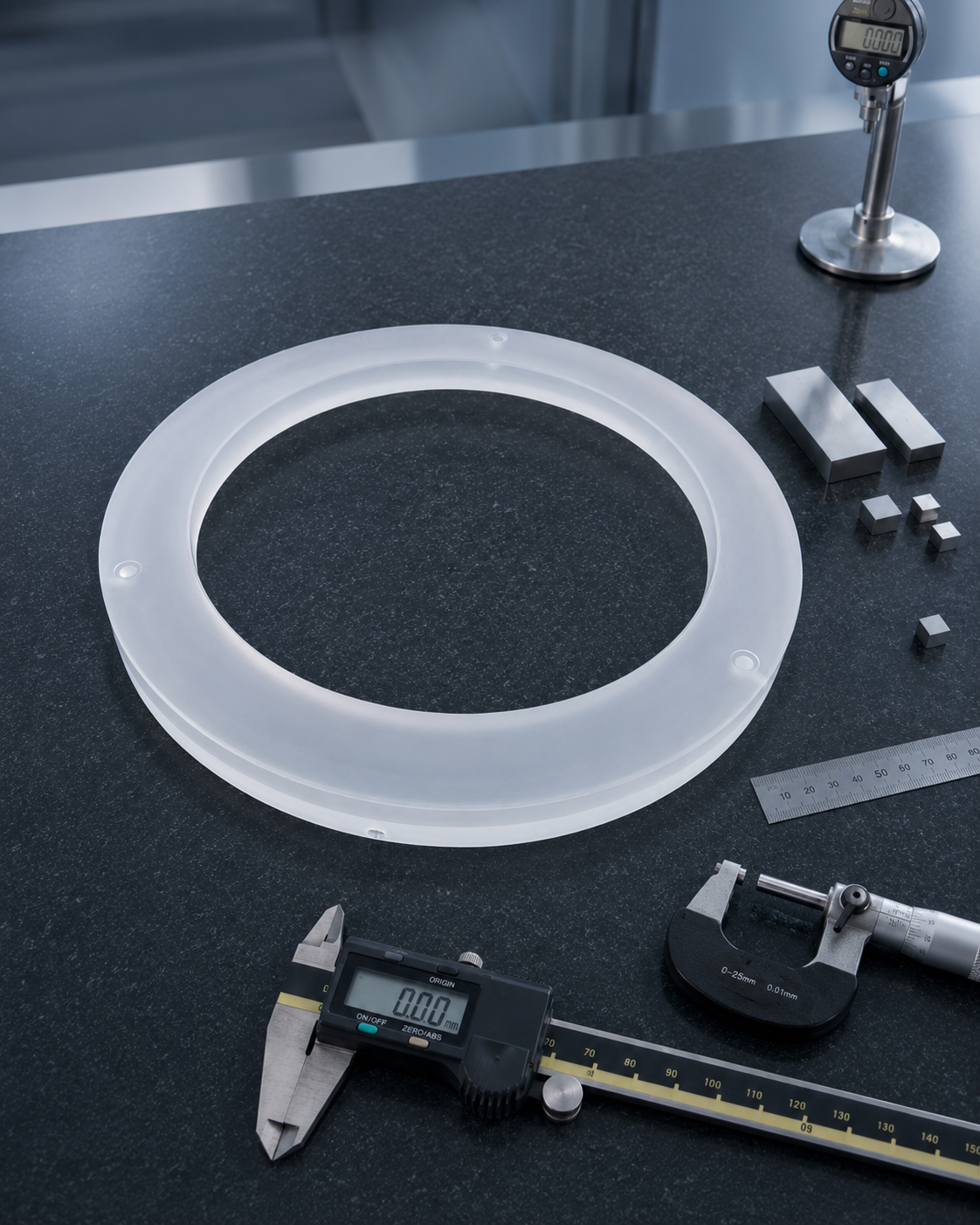
Silicon dioxide glass is hard and brittle. It cannot be machined like metal. Complex shapes, tight tolerances, and polished surfaces usually require diamond grinding, skilled finishing, and controlled inspection.
Tubes and plates may also begin as flame-formed or melted stock. Heating and cooling can lock internal stress into the glass, so controlled annealing is often needed before precision work.
Representative properties
The figures below are typical room-temperature values for fused quartz and fused silica. Treat them as a starting point, not a final specification. Exact values vary by grade, producer, forming method, and the datasheet tied to the material actually supplied.
| Category | Property | Typical value |
|---|---|---|
| General | Chemical composition | SiO₂, typically ≥ 99.9% |
| Mechanical | Density | ~2.2 g/cm³ |
| Mechanical | Knoop hardness | ~570 (≈ Mohs 6–7) |
| Mechanical | Young’s modulus | ~72 GPa (10.5 × 10⁶ psi) |
| Mechanical | Tensile strength | ~48 MPa (~7 kpsi) |
| Mechanical | Flexural strength | ~50–110 MPa, grade-dependent |
| Mechanical | Compressive strength | ~1100 MPa (~160 kpsi) |
| Mechanical | Poisson’s ratio | ~0.17 |
| Thermal | Coefficient of thermal expansion | ~0.55 × 10⁻⁶ /°C |
| Thermal | Thermal conductivity | ~1.4 W/m·K |
| Thermal | Max. working temperature | ~600–1000 °C, depending on short-term or continuous use |
| Optical | Refractive index | ~1.459 at 587 nm |
| Optical | Transmission band | ~0.18–3.5 µm, UV to near-IR, grade-dependent |
| Electrical | Dielectric constant | ~3.8 at 1 MHz |
| Electrical | Volume resistivity | ~10¹⁸ Ω·cm at room temperature; falls steeply when heated |
Where fused quartz and fused silica are used
Machined fused quartz and fused silica appear in semiconductor fabrication equipment, laboratory instruments, analytical apparatus, microwave components, and optical elements such as windows, lenses, and mirror substrates.
Not sure which quartz glass grade you need?
Send us the drawing, wavelength, temperature, and working environment. We will help review whether fused quartz, fused silica, or a specific grade is the right starting point before quoting.
Discuss a material requirement →